

If you’re a coach and you’ve ever thought…
“Who am I to be doing this?”
“I don’t know what I’m doing!”
“There are so many better coaches than me.”
“I don’t feel ready to launch a business yet…”
You’re not alone.
Imposter syndrome is one of the most common experiences I see—across all stages of a coaching business.
And here’s the part that might surprise you:
It doesn’t go away just because you get more experience. Even after 25 years in coaching, I still notice it showing up.
So the real question isn’t how do we eliminate it completely?
The question is…
What is it really—and how do we move through it?
What Imposter Syndrome actually is. Imposter syndrome isn’t proof that you’re a fraud.
It’s a signal that you’re in a growth stage.
There is a grain of truth underneath it—but not the one most people think.
It’s not: “I shouldn’t be doing this.”
It’s more like:
→ “This is new.”
→ “I’m still learning.”
→ “I haven’t done this exact thing before.”
There are a few key reasons imposter syndrome becomes a block:
1. You’re Comparing Your “Inside” to Someone Else’s “Outside”
You see another coach:
- Confident
- Polished
- Successful
And you assume they feel that way all the time.
They don’t.
You’re comparing your internal doubts to their external presentation—and that comparison will always make you feel like you’re behind.
2. You’re Trying to Operate Outside Your Stage
This is a big one.
If you’re in the early stages of your coaching business, but trying to:
- Market like an advanced coach
- Speak like a seasoned expert
- Build offers you’re not ready to deliver
You’ll feel like an imposter—because you’re skipping steps.
There’s a natural progression to building a coaching business.
When you honor your stage, confidence comes much more naturally.
3. You Lack Clarity in Your Niche and Message
When you’re not clear on:
- Who you help
- What problem you solve
- What transformation you offer
It creates a constant feeling of uncertainty.
And uncertainty fuels imposter syndrome.
Clarity builds confidence.
4. You’re Avoiding Real Experience
This is the one most people don’t want to hear.
Confidence doesn’t come from:
- More certifications
- More learning
- More preparation
It comes from working with real people
AND
Knowing how to promote yourself.
There was a time when I transitioned into relationship coaching.Even with years of experience—and additional training—I felt like an imposter. I was in the middle of a divorce. Who was I to help people’s relationships?!
What changed everything?
- Working with real clients.
- Finding my niche in the area of relationships.
With that combination, I did research, found books and other experts to support my work, and created my own program based on my personality and what my ideal clients wanted most.
Not more courses.
Not more credentials.
Actual conversations.
Actual experience with real people.
Actual results.
That’s where confidence is built.
The Trap of Comparison (and Why It Backfires)
At one point, I invested in a high-level coach whose presence and confidence I admired. She had a best-selling book at the time and was operating at the level I wanted to be operating.
I hired her as my coach, and I followed everything she guided me to do to grow my business with a workshop. And when I launched my workshop…
Two people showed up.
That experience taught me something important:
You can’t compare your path to someone else’s—and expect it to work.
You can’t compare your inside experience with others’ outside presentation.
People are showing curated versions of themselves.
- Different stages.
- Different strengths.
- Different journeys.
Comparison doesn’t just hurt your confidence—it distorts your strategy.
So what is the opposite of Imposter Syndrome?
It’s not perfection.
It’s not knowing everything.
It’s self-trust.
Self-trust sounds like:
- “I can figure this out.”
- “I don’t know everything—and I don’t need to.”
- “I trust the coaching process.”
- “I trust myself with my clients.”
- “I know I need help with the business-building stuff that I don’t know.”
Early in my business, I learned a concept that changed everything: Be both vulnerable and credible.
Instead of pretending to have all the answers, you say:
- “Here’s what I’ve experienced.”
- “Here’s what I’ve learned.”
- “Here’s how I can help.”
- That combination builds real trust.
Here is one way to shift your mindset.
Look Back at Your Evidence
Where have you:
- Helped someone?
- Created a shift?
- Made an impact?
Your past is proof.
Stay in Your Stage
- Don’t skip steps.
- Build what’s aligned with where you are—not where you think you “should” be.
Be Honest About What You Don’t Know
- You don’t need to pretend.
- People trust honesty more than perfection.
Imposter syndrome isn’t a sign you’re doing something wrong. And the goal isn’t to eliminate it completely.
The goal is to build enough self-trust that it no longer stops you.

Ready for the Next Step?
If you’re in the early or growth stage of your coaching business and want support building clarity, confidence, and real momentum…
 Explore the Soul-Driven Success Business Academy
Or start with the Soul Strategy Vision Course to get clear on your direction
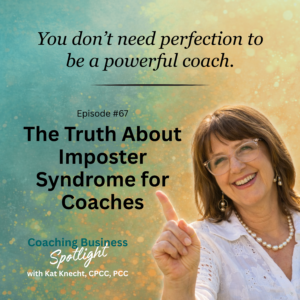 Ep. 67 – Kat Knecht – The Truth About Imposter Syndrome for Coaches
Why do so many coaches struggle with imposter syndrome? Kat unpacks the real cause, the role of comparison, and how self-trust helps coaches grow a confident, aligned coaching business.